When Your Family Wants to Pay for Medical Treatment
Story Highlights
- A tertiary of U.Southward. adults say their family couldn't beget care in past year
- I in 4 say intendance was deferred for a serious medical condition
- Lower-income adults and Democrats near likely to written report delayed care
WASHINGTON, D.C. -- A record 25% of Americans say they or a family member put off treatment for a serious medical condition in the by twelvemonth because of the toll, up from nineteen% a year ago and the highest in Gallup'due south trend. Another 8% said they or a family member put off handling for a less serious condition, bringing the total percentage of households delaying intendance due to costs to 33%, tying the high from 2014.
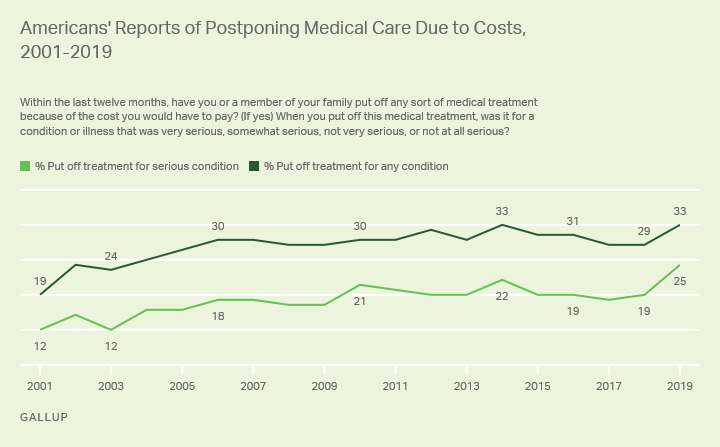
Gallup get-go asked this question in 1991, at which time 22% reported that they or a family member delayed care for any kind of condition, including 11% for a serious condition. The figures were similar in the next update in 2001, and Gallup has since asked this question annually as part of its Health and Healthcare poll. This yr's survey was conducted Nov. 1-14.
Americans' reports of family members delaying any sort of medical treatment for toll reasons were lower in the early on to mid-2000s when closer to a quarter reported the trouble. Since 2006, the charge per unit has averaged 30%.
The pattern is similar for the subset of Americans postponing medical handling for a serious condition. The charge per unit rose from 12% in 2001 to an boilerplate of 19% since 2006. However, the current 25% is the highest withal, exceeding the prior high-bespeak of 22% recorded in 2014.
Income Gap Widens for Cost-Related Delays for Serious Atmospheric condition
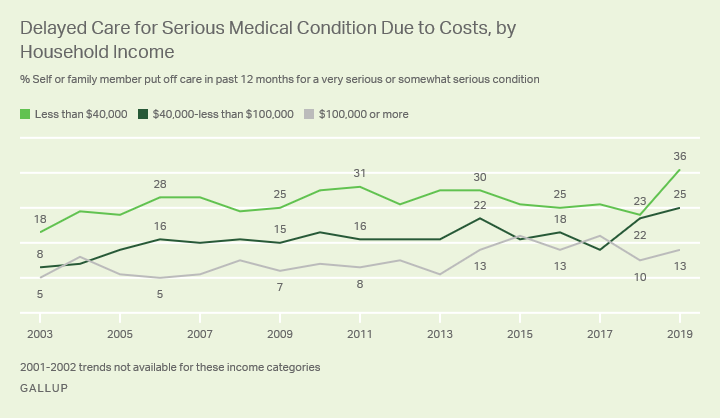
Reports of delaying treatment for a serious condition jumped thirteen percentage points in the past twelvemonth to 36% amongst adults in households earning less than $40,000 per year while it was essentially apartment (up a non statistically significant three points) amid those in middle-income and higher-income households.
Equally a result of the spike in lower-income households this yr, the gap betwixt the top and bottom income groups for failure to seek treatment for a serious medical condition widened to 23 percentage points in 2019. The income gap had averaged 17 points in the early years of Barack Obama's presidency, but narrowed to an average xi points in the first few years afterward implementation of the ACA, from 2015 to 2018.
Delayed Care Up Most Among Those With Pre-Existing Conditions
Reports of delaying intendance for a serious condition due to costs are also up xiii points compared with final twelvemonth amid Americans who report they or another household member has a "pre-existing condition."
At the same time, there has been virtually no alter in the percentage of adults without pre-existing conditions in the household who delayed intendance for a serious health upshot in the past yr, currently 12% versus eleven% in 2018.
Changes in health insurance coverage don't appear to exist the cause of the increase in delayed intendance equally the percentage uninsured is eleven% in the poll, inside the 9% to xi% range seen each year since 2015. Also, the percentage delaying care has increased a like proportion amongst those covered past private health insurance or Medicare/Medicaid too every bit among the uninsured.
Contempo Reports of Delayed Intendance May Have a Partisan Component
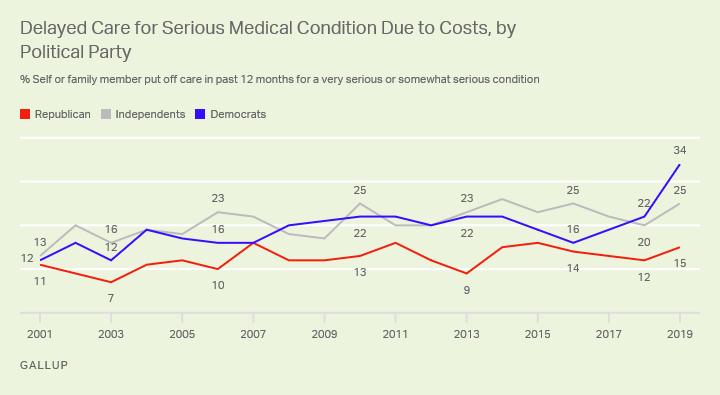
A cautionary note in the new findings is that most of the contempo increase in reports that family members are delaying handling for serious conditions has occurred amidst self-identified Democrats. This is upwardly 12 points since 2018 among Democrats, compared with three- and v-point increases amid Republicans and independents, respectively.
This ties in with Democrats' college likelihood than Republicans of reporting that they or a household family member has a pre-existing medical condition.
Whether these gaps are indicative of real differences in the severity of medical and fiscal bug faced by Democrats compared with Republicans or Democrats' greater propensity to perceive problems in these areas isn't entirely clear. But it's notable that the partisan gap on putting off care for serious medical handling is currently the widest it'due south been in 2 decades.
Implications
Since 2001, Gallup has tracked a near 50% increase in the percent of Americans proverb that they or a family member chose not to get medical intendance because of the costs they would have to pay. Such delays in medical treatment, whether for injuries, illnesses or chronic conditions, can have pregnant implications for the economy and healthcare organisation, simply also the political climate.
One indicator of the stress that delayed care tin put on the healthcare system is the use of emergency departments. According to the American Hospital Association, patient visits to emergency departments in community hospitals increased 19% between 2001 and 2016 and has likely climbed to over 20% by today. While that may reflect many factors, including the aging of the population and the number of Americans living in close proximity to hospitals, information technology may as well be indicative of a greater demand for emergency intendance due to lack of routine care.
While most of the increase Gallup sees in delayed treatment occurred over a decade ago, the sharp increase in the past twelvemonth, specially amidst Democrats, suggests that healthcare costs could be a more stiff political issue than previously seen. Presidential candidates who admit the problem and advise solutions to accost it may discover a receptive ear among voters.
From an economic perspective, delayed intendance can have a range of negative effects, including reduced workplace productivity in the brusque-term, and increased healthcare costs and in the long-term -- costs that ultimately burden the federal budget which has ripple effects on the economy.
View complete question responses and trends (PDF download).
Larn more about how the Gallup Poll Social Serial works.
Source: https://news.gallup.com/poll/269138/americans-delaying-medical-treatment-due-cost.aspx
0 Response to "When Your Family Wants to Pay for Medical Treatment"
Post a Comment